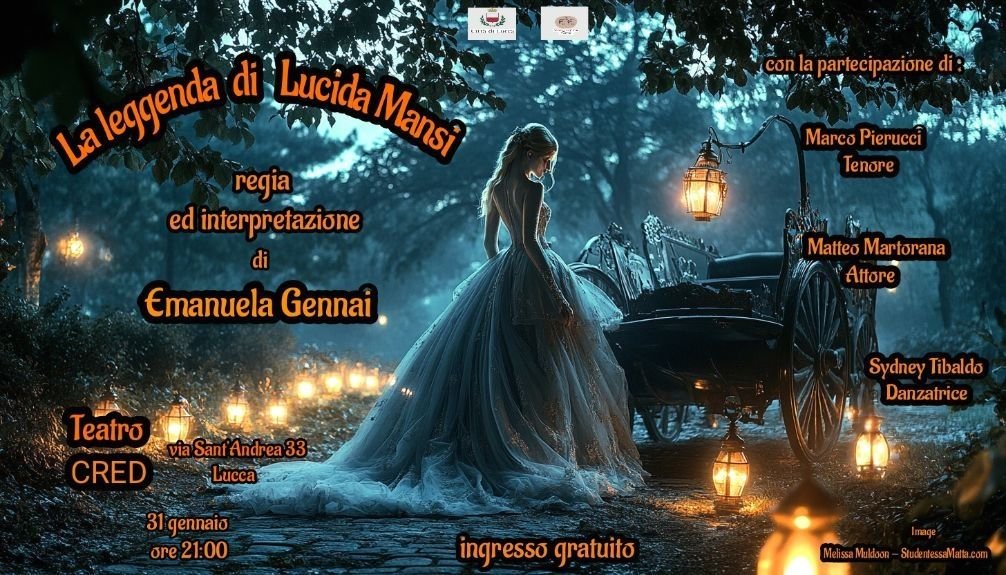
This Saturday, 31st January, at 9 pm, in the small theatre of the Cred space in Via S. Andrea, in the historic centre, there will be a theatrical reading entitled: The Legend of Lucida Mansi, in which the protagonist of the story will be played by Emanuela Gennai. (IN ITALIAN) FREE ENTRY
Emanuela Gennai, presenter, actress and engaging narrator, a well-known face in the city and always very active in our area, says she is very happy to bring this event to the stage, but above all to play one of the most mysterious and famous characters in Lucca's folklore.
The event is conceived, curated and performed by Emanuela Gennai herself, with the patronage of the Municipality of Lucca, and is part of the Vivilucca events calendar. On stage, there will be an exceptional cast, chosen by her: tenor Marco Pierucci, actor Matteo Martorana and dancer Sidney Tibaldo.
The legend, set in the 17th century and well known and appreciated throughout the world, tells the story of a noblewoman obsessed with beauty who, seeing the passing of time, makes a pact with the devil to obtain thirty years of eternal youth in exchange for her soul. but when the time expires, she is kidnapped by the devil and dragged onto a fiery carriage, plunging into the lake of the Botanical Garden of Lucca, where her spirit, it is said, still appears today.
‘This legend,’ explains Emanuela Gennai, ‘also conveys messages. It is intended as a warning about vanity, the fear of ageing and the obsessive pursuit of beauty, a pursuit that is increasingly strong today and for which we are often willing to pay a high price.’
Lucida Mansi was a noblewoman from Lucca, most likely belonging to the Samminiati family, who lived in the province of Lucca in the first half of the 17th century. She married Vincenzo Diversi at a very young age, but he was murdered a few years after the wedding. Left a widow, she remarried the elderly and wealthy Gaspare di Nicolao Mansi, a marriage that caused a stir due to the disproportionate age difference and Lucida's beauty. It was precisely her attractiveness and strong desire for escapism that led her to lose all dignity and have many young lovers, who would meet a bad end. Furthermore, the noblewoman was so obsessed with her beauty that she had an entire room of Villa Mansi in Segromigno in Monte covered with mirrors so that she could always admire herself on every occasion. According to some documents that have come to light, Lucida Mansi seems to have died of the plague in February 1649 and her remains were buried in her family's crypt in the Church of the Conception of the Capuchins in Via Elisa, which no longer exists today.
‘In this theatrical reconstruction,’ continues Emanuela Gennai, "I want to highlight Lucca's identity and transport the audience between reality and myth